


Dragasani Vineyard
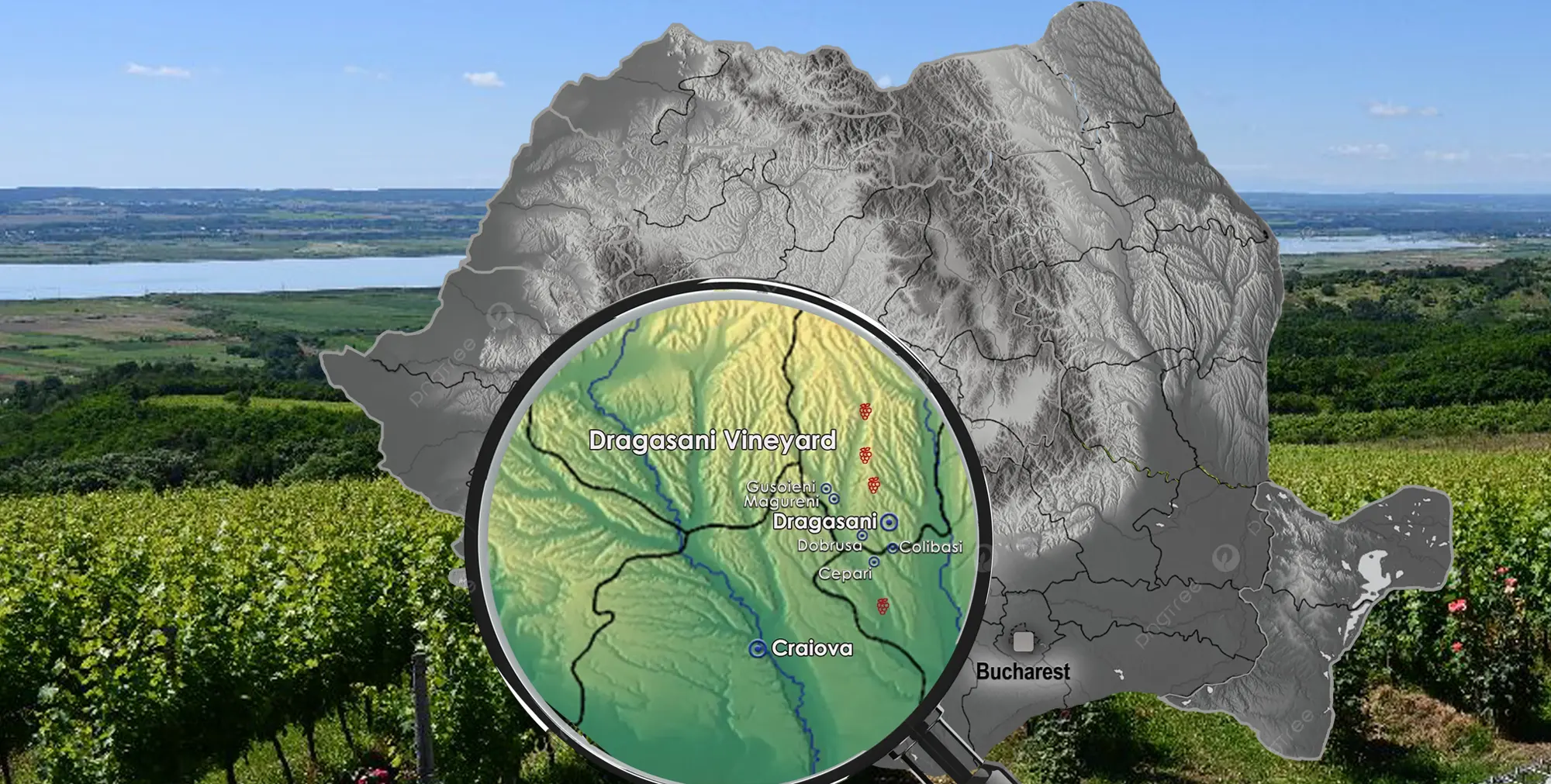
The Dragasani wine region, one of the oldest and most esteemed in Romania, extends across the hills of the Piedmont area along the lower Olt and its main tributaries, encompassing areas of Vâlcea and Olt counties. The age of the vineyards on these fascinating, historically rich lands can hardly be precisely determined, as it is closely connected to the initial plantations by the Geto-Dacians. Professor I.C. Teodorescu eloquently captured the essence of Dragasani in his work "The vines of Dacia and the Romanian Principalities" (Teodorescu I.C., 1943), stating: "In a wonderful and indescribably harmonious environment, the Dragasani have been honored since the world knew them... Anyone passing by the waters of the Olt, upstream from Dragasani, should bow in reverence to this magnificent and unique temple of the land."
View MapThe Dragasani Vineyard extends between the Getic Subcarpathians to the north and the Romanian Plain to the south and southeast, situated between parallels 44º30' - 44º55' north latitude and meridians 23º55′ – 24º15′ east longitude. The relief is characterized by a complex of hills and narrow hills with altitudes ranging from 200 to 500 m. The dominant soils in the vineyard consist of clays with traces of limestone, sand, gravel, and marl. The climate is temperate continental.
The Dragasani vineyard stands out for three unique grape varieties: Cramposie Selectionata, Negru de Dragasani, and Novac, all possessing significant potential for producing quality wines that can represent the country on the international stage. Abundant in the vineyards of Dragasani are other traditional Romanian varieties such as Feteasca Alba, Feteasca Regala, Tamaioasa Romaneasca, or Feteasca Neagra.
In recent years, the Prince Stirbey Winery and the Bauer Winery have successfully crafted exceptional sparkling wines using the traditional Champenoise method.
A quick look - Dragasani Vineyard
Please Choose Your Wines from Dragasani Vineyard